
Identify a Madison County Owner
Madison County ties its land records together with a map-and-parcel number. An address is only a first clue. QPublic turns that address into a tax-roll owner and a parcel key. From there, the Clerk of Superior Court's deed index shows the grantee on the most recent recorded transfer. The grantee is the party who received the property. Using both sources together is the sound way to identify an owner of record. It matters most when a purchase, boundary dispute, estate, or deed-fraud worry makes timing critical.
- Search the street address through the Madison County QPublic entry. Copy the map-and-parcel number exactly, including letters and hyphens.
- Read the owner or current-record-holder name and keep the mailing address distinct from the land's situs address.
- Search that name in the Clerk's local index or GSCCCA. Match the newest deed by legal description, parcel clues, and book and page.
- If an LLC holds title, check the Georgia Corporations Division. For a trust or estate, use the recorded deed and nonconfidential probate file.
The assessor sets value and taxability. It issues no title opinion. The latest deed is stronger recorded evidence, though liens, life estates, or other interests can still call for professional title work.
Read Madison County Owner Fields
Tax-sale notices show the local distinction that matters most. "Current Record Holder" and "CRH Address" appear apart from the property "known as" a street address. The first pair is the tax-roll party. It is also the mailing destination. The other is the situs, the physical location of the land. A mailing address may be an office, post box, trustee address, or another home entirely.
The county describes QPublic as reflecting its current published tax digest. Vendor parcel cards may use different labels, so treat the digest as the reference. Did a closing just happen? Skip the guessing and check the newest recorded deed. Do not count how many days the roll needs.
Note: A mailing address that differs from the situs does not prove the owner lives elsewhere. It also does not show a lack of possession.
Confirm Madison County Deed Ownership
The local Madison recorder index searches by grantor or grantee, legal description, book and page, and recording date. A grantee is the person or entity that received the interest. Match the newest conveyance to the QPublic parcel. Use subdivision, lot, block, acreage, Georgia Militia District, and any prior book-and-page reference.
GSCCCA's central deed index covers Madison records from January 1, 1999 forward. For earlier deeds, the local notice points to the Clerk's physical office. That office route also helps when a web result is unclear. Use the public terminal or ask staff for a known book and page. Limited-use GSCCCA access shows summary results but no deed images. A regular account permits images and charges for printed pages.
Madison County Ownership Sources
No single database lists every interest in Madison County land. Each official source answers a narrower question. The parcel identifier keeps those answers tied to one tract. The official QPublic assessor landing page is the county's published entry to parcel data. It also serves owner data from the same source.
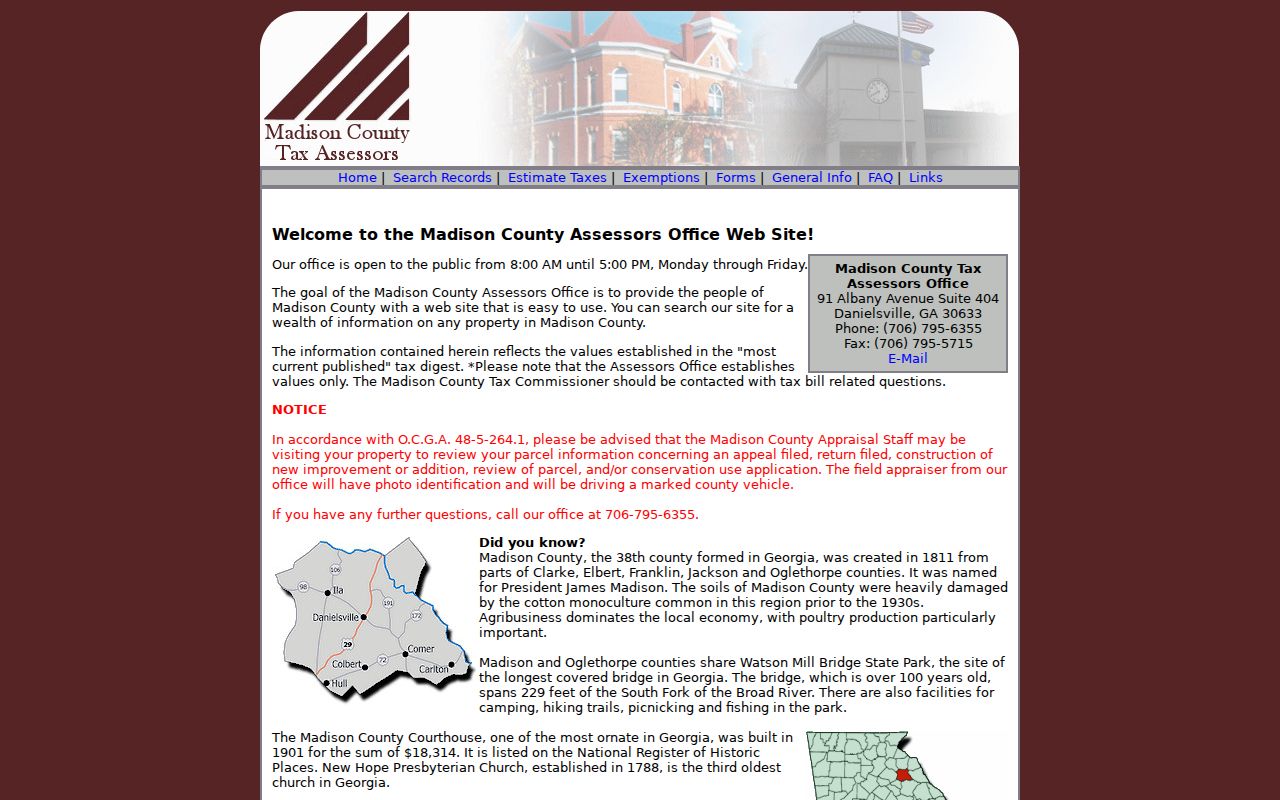
This county-branded page is the official assessor source. Confirm it before matching any owner name to a deed.
| Where Ownership Is Shown | What It Gives | How Current |
|---|---|---|
| Board of Assessors / QPublic | Tax-roll owner, mailing clue, situs, parcel, value | Current published digest; exact transfer lag not published |
| Clerk / deed index | Latest grantee, instrument, legal description, book/page | Local index may lag close-of-business recording |
| QPublic property map | Parcel location linked to assessment data | Reference mapping, not title proof |
| Georgia eCorp | Business status, agent, officer search | Entity filing record, not personal title |
The current-owner answer is strongest when the tax roll and latest deed agree. If they differ, record both dates. Contact the custodian rather than picking whichever result looks newer.
Decode Madison County Owner Terms
Ownership records use short terms with different legal weight. Knowing the distinctions keeps a parcel-card name from being mistaken for a complete title finding.
- Owner of record
- The party carried on an official roll or recorded instrument; the source and date matter.
- Grantee
- The party receiving the interest described in a deed.
- Title
- The legal rights in land, which may be divided or burdened and are not proved by one index result.
- Situs address
- The physical property location, distinct from the owner's correspondence address.
- Vesting
- The way an ownership interest is held, such as by individuals, trustees, or an entity.
A deed may reserve a life estate or convey only part of an interest. Read the instrument, not its index line.
Entities in Madison County Records
An LLC name on the roll can be checked through the Georgia eCorp Business Search. You can search by business name, control number, registered agent, or officer. The filing identifies the entity and its public business contacts. It does not prove an agent or officer personally owns the land.
Trust records may name a trustee rather than beneficiaries. Estate property can require the probate docket and the will. Executor or administrator authority may matter too. A later recorded estate deed can complete the chain. Most Madison probate files before 2017 are not scanned. An office request may be the shortest path. Life-estate wording likewise explains why a tax-roll holder rarely tells the whole story.
Owner Alerts for Madison Filings
Georgia's free Filing Activity Notification System is called FANS. It sends an alert when clerk-transmitted index data matches owner or address criteria. It looks forward only. It does not recreate older ownership, guarantee prompt data, or replace a title search. Registration is limited to owners and authorized users, not general research.
The alert earns its keep after confirming who owns a Madison County property. An unexpected deed or lien notice can prompt a fast check with the Clerk. The Georgia Attorney General also points owners toward FANS in its title-theft guidance.
Where Madison County Ownership Lives
Ownership information in Madison County sits in two offices. The Board of Assessors builds the annual digest. The Superior Court Clerk records deeds, liens, plats, and security deeds. The Tax Commissioner then bills and collects using the assessment data. Planning, municipal desks, and 911 addressing add context for permits and locations. None of them replaces the deed itself. Land inside Comer, Colbert, or Danielsville still runs through Madison County for recording and assessment. A permit inside city limits may also need municipal approval. Keep one distinction in mind. Postal names and municipal boundaries rarely match. Rely on the parcel number and legal description whenever jurisdiction matters.
Limits on Madison County Owner Lookups
A public owner name has limits. It does not tell you who lives in the house, who might inherit it, or whether someone else holds a lien, easement, security deed, or life estate. QPublic is an assessment source, not a title answer. A GIS line is not a survey, and even a deed index stays just an index until you read the instrument and its related filings.
Lawful use. Madison County owner information may support purchase research, boundary work, estate questions, or civic review. Never use it to stalk, harass, intimidate, or harm anyone.
Georgia law protects some public addresses. Qualifying VoteSafe participants are one example. Respect redactions and restricted records, and when legal title controls a transaction, rely on the Clerk's certified records and qualified professional help.
Resolve Madison County Owner Gaps
A blank address result is not proof the land has no owner record. The search key is often the problem. Strip a unit, suffix, direction, or punctuation and retry QPublic. For a newly assigned address, contact Madison County 911 Addressing and search by map-and-parcel number. Keep every zero, letter, and hyphen intact, because county legal notices use several identifier formats. Business owners take extra care. Search the exact entity name plus punctuation-free variants. Then turn to Georgia eCorp to identify the business record. For a trust, try the trustee name along with the trust name. For an estate, search executor, administrator, estate, and heir wording. Request older probate files if the online module stops short. These sources explain why a name appears. Yet the newest matching deed remains the recorded ownership check. Older ownership also has an offline route. Madison's GSCCCA coverage runs reliably from 1999. The local recorder directs pre-1999 work to the Clerk. Bring the latest book and page, name variants, the parcel number, and the legal description. A focused request lets staff move from the public terminal into the deed books. That way no one depends on a modern address that may not exist in the older record.
Write down the date and source of the final owner result. That habit makes any later deed or digest change easier to explain.