
Read Madison County Property Tax Records
The Board of Assessors sets the annual digest for every parcel. That covers ownership, location, taxability, fair-market value, and exemptions. The Tax Commissioner bills and collects. Keeping the two roles apart is the first step toward reading a Madison County property record the right way.
| Field | What It Shows | Where |
|---|---|---|
| Fair-market value | Assessor estimate as of January 1 | Annual digest |
| Assessed value | Georgia's 40 percent assessment level | Assessor record |
| Exemptions | Approved tax relief or special treatment | Assessors Office |
| Tax bill and status | Charge, payments, balance, or delinquency | Tax Commissioner |
| Map and parcel | Key connecting roll, map, and bill | QPublic and tax account |
Market value is not the bill. Assessed value is no sale price. The owner on the digest is not a title opinion either; each field is evidence for a defined county task, and only the actual current bill controls the amount due.
Two Madison Offices Divide Value and Collection
Two Madison County offices split the work. Valuation and exemption questions belong to the Assessors Office. That office sits at 91 Albany Avenue, Suite 404, Danielsville, 706-795-6355, open weekdays 8 a.m. to 5 p.m. Bill, payment, delinquency, timber-tax, tax-sale, and excess-funds questions go to Tax Commissioner Lamar Dalton. His office is Suite 14, 706-795-6385, weekdays 8 a.m. to 4:30 p.m. Have the tax year and map-and-parcel number ready with either office.
Neither office handles the other's job. Paying a balance does not change the value. An assessor cannot post a collection payment. The official Tax Commissioner source lists the billing office and its service scope. Review the Madison County collection page before choosing a payment channel.

The page routes taxpayers to current bills, partial payments, tax-sale material, and excess-funds forms.
Look Up a Madison County Tax Bill
Begin at Madison QPublic when the parcel key is unknown. It mirrors the most current published digest. Its live Schneider search is protected, so rely on the documented address, owner, and map-and-parcel paths rather than assuming extra fields.
- Search the roll by address or owner and copy the map-and-parcel number exactly.
- Confirm the tax year, current record holder, mailing address, legal description, and values match the tract.
- Open GovernmentWindow or contact the Tax Commissioner and locate the bill with the parcel key.
- Read the bill year, charge, payments, balance, and due status; verify a time-sensitive payoff with the office.
- Assessed value
- Forty percent of fair-market value under Georgia's standard level.
- Millage
- A tax rate in mills applied to taxable assessed value.
- Homestead exemption
- Relief for an eligible owner-occupied home after approval.
- Tax lien
- A claim arising from unpaid tax, separate from the assessment.
Madison's September-to-December Tax Cycle
Real and personal property bills generally mail in September. They normally come due December 20. The printed bill controls, and partial payments are accepted. Mobile-home bills generally mail in late January and fall due April 1, though tax on a homesteaded mobile home may appear on the end-of-year property bill.
Standing timber runs a different path. It is assessed once, at harvest or sale, at 100 percent of fair-market value. Timber deeds must be stamped in the tax office before the Clerk records them. Identify the property class before comparing dates or balances.
Note: Use the due date printed on the current Madison County bill whenever it differs from the county's normal calendar.
Madison County's Digest Uses the 40 Percent Rule
Property is valued as of January 1 for the annual digest. The county explains that assessed value is 40 percent of fair-market value before relevant exemptions shape taxable value. Adopted millage is then applied for taxation.
The county may visit property to measure structures, list improvements, and take photographs. Staff carry photo identification and use a marked county vehicle. Those reviews support valuation; staff do not collect the resulting bill.
A digest record is not a private appraisal. Market conditions, the condition on a later date, financing, and terms of a sale can produce a price different from the assessor figure.
Apply for Madison Homestead and Land Relief
Assessor materials list standard homestead, age-65 county and school, age-62 school, disabled-veteran, and surviving-spouse categories. They also cover conservation and current-use, preferential agricultural or forest, Freeport, and law-enforcement nondisclosure. Eligibility varies. A place on the list does not prove any parcel qualifies.
Homestead applications and annual returns fall due April 1 under county guidance. Current-use conservation carries a 10-year covenant. Review the official exemption explanations. Then obtain current homestead, age-based, or PT-283A forms from the assessor.
Colbert runs its own city homestead exemption. It covers qualifying owners inside city limits. Confirm that benefit directly with Colbert City Hall. Do not infer eligibility from a postal address.
Appeal a Madison County Assessment in Writing
An assessment notice opens a 45-day window for a written appeal. Madison County requires a United States Postal Service postmark by the deadline on the notice. Electronic appeals are not accepted. Value, taxability, uniformity, and denial of exemption can all be appealed.
Identify the parcel, tax year, issue, and proposed correction. Support can include a recent arm's-length sale, comparable parcels, repair facts, photographs, survey evidence, or proof that the roll describes the property incorrectly. Keep a full copy. Keep proof of mailing too.
The official Madison appeal instructions describe Board of Equalization, arbitration, and Superior Court routes.
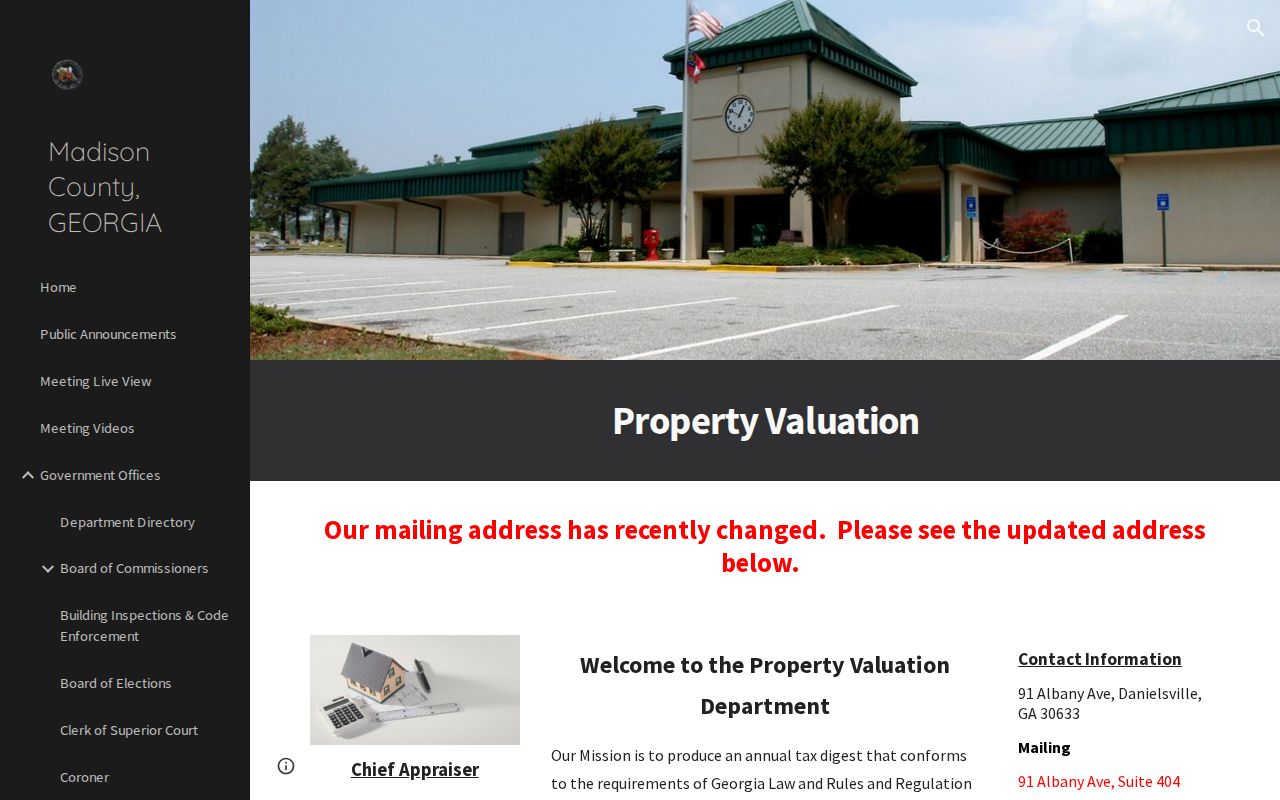
The captured instructions confirm the written, postmarked process and available formal paths.
Protect the appeal window. File the written Madison County appeal within 45 days of the notice and obtain a timely USPS postmark; email is not accepted.
Find Madison Board Records Beyond the Parcel Card
The Board of Assessors meets the second Thursday of each month at 5:30 p.m. to consider conservation applications, homestead exemptions, preferential treatment, and changes in tax status. Posted calendars and selected agendas or minutes can supply policy context a parcel card never shows.
Only limited years appear online. Older records take a request. Ask County Clerk Christina Baxter at cbaxter@madisonco.us or 706-795-6300. Georgia's Open Records Act gives any person access to existing public records and generally requires a response within three business days. It allows a 10-cent photocopy baseline plus reasonable production costs after the first free quarter hour.
Ask for a specific meeting date, parcel, application, or decision. Vague requests slow things down. The agency need not create a new report that does not exist. Specificity gets better results.
Trace Madison Tax Sales and Excess Funds
Tax sales in Madison County begin with public notice. The Madison County Journal, the county's legal organ, prints the sale notices. One notice can carry a map and parcel number. It may also list the defendant, the current record holder and mailing address, the amount due, the tax years involved, a reference deed, and the legal description. Treat every field as a lead. Confirm each one against the official tax and deed files before acting on it.
Money sometimes remains after a sale covers the taxes and costs. The Tax Commissioner keeps an Application for Excess Funds Request. It also keeps a current list of remaining excess funds. Priority and eligibility rest with that office's review. Rely on it rather than the notice alone. A published notice also proves nothing about ownership. For that, read the deed recorded after the completed sale.
Tax evidence is not title proof. A bill, delinquent notice, or tax-roll owner identifies the account, but the latest recorded deed confirms the ownership transfer.
Request Madison Tax Records When Portals Stop
Online payment runs through GovernmentWindow, but access can fail without warning. Skip assumptions and go straight to the Tax Commissioner by phone or in person. Bring the map-and-parcel number, tax year, owner name, and property address. Say upfront what the request involves. It may be a bill, payment history, delinquency, a sale, or excess funds. The clearer the question, the faster the answer.
An existing record that no portal offers can still be requested in writing. The request falls under the Georgia Open Records Act. Madison County names County Clerk Christina Baxter as its Open Records Officer. Reasonable charges for search, redaction, production, media, mailing, or certification may apply. Prepayment can be required. Ask for a record that exists, not a custom tax summary built by staff.
Need proof of payment or a certified copy? Ask the Tax Commissioner which form the office issues and the fee. The office's current quote controls.
Match Madison Assessment Notices to the Right Parcel
An assessment notice only matters if it matches the right parcel. Check it against the property as it stood on the January 1 valuation date. Compare the map-and-parcel number, owner and mailing address. Compare acreage, legal description, and the fair-market and assessed figures. When a structure, land area, exemption, or ownership field looks wrong, save the notice. Then gather the record that backs a correction.
Support takes several forms. Recent deeds and surveys can settle ownership or acreage disputes. Dated photographs and repair records may back up a condition claim. Comparable sales work best when the property is reasonably similar in location and use. A later tax bill counts for nothing here. It speaks to a different stage than the assessor's valuation date.
Board minutes explain broad policy. A parcel-specific appeal demands parcel-specific proof. When the contents matter, ask the Assessors Office for the existing property-review or appeal file. The county may redact protected personal data. Any withheld portion, though, should come with its legal basis identified.
The record trail does not end at a decision. Check both systems again afterward. A changed assessment must flow through the tax process before any bill reflects it. Keep the written decision, the corrected roll entry, and the revised bill together. That paper trail lets every step of the Madison County property tax record be verified.